An Unexpected Diagnosis of Pancreatic Cancer
Zulfiia, 72, is a university teacher from Russia. In September last year, she visited a hospital due to dull pain and discomfort in the upper right abdomen. An ultrasound suggested gallstones. Before treatment, she underwent an enhanced abdominal CT scan. The results revealed more than just stones—a 21×19 mm mass in the pancreatic head, multiple lesions in the liver, and enlarged retroperitoneal lymph nodes.
This sudden news completely disrupted her life. After learning about her condition, Zulfiia spent over a month undergoing various examinations locally and was diagnosed with pancreatic head cancer with multiple systemic metastases (liver, bones, etc.). Her condition progressed rapidly. Within just one month, she lost the ability to walk, her right leg became weak, and she suffered severe pain in her chest, back, and abdomen. A subcutaneous mass also appeared on her back.
Local doctors recommended chemotherapy, but the long waiting time meant her condition could not afford further delay. By chance, her family came across stories on social media about Russian patients receiving treatment at Guangzhou Fuda Cancer Hospital in China. Holding onto a final hope, they contacted the hospital’s Moscow office. After detailed consultations, Zulfiia and her family decided to travel to Guangzhou for treatment.
A Turning Point Begins Here
When Zulfiia arrived at Guangzhou Fuda Cancer Hospital, her condition was poor. She could not walk independently and even worried that the hospital might refuse to treat her. Examinations showed her condition was more complex than expected: the pancreatic tumor had grown to 58×54×74 mm, invading the posterior wall of the gastric antrum and the duodenal wall, with multiple metastases in the liver, lymph nodes, and bones.
Faced with such a challenging situation, the medical team from the Fourth Department at Fuda did not retreat. They developed a cautious, step-by-step treatment plan.
The team first performed a biopsy of the mass on her shoulder and back to determine its nature. The result indicated metastatic adenocarcinoma, likely originating from pancreatic cancer. After admission, Zulfiia developed unstable angina, making her temporarily unsuitable for interventional arterial infusion chemotherapy. The team adjusted the treatment plan, starting with supportive therapies such as myocardial nutrition and vasodilation, followed by oral chemotherapy combined with immunotherapy and targeted therapy. The goal was to control the disease while minimizing additional burden on her body.
After three treatment cycles, encouraging changes gradually appeared. From being bedridden and needing assistance, Zulfiia was eventually able to walk on her own. Her pain was effectively relieved, and her weight began to increase. What surprised her most was that, during treatment, her hair did not fall out as expected—instead, it even started to grow. These subtle improvements greatly boosted her confidence.
As her condition stabilized, the medical team proceeded with interventional therapy. This treatment delivers chemotherapy drugs directly into the arteries supplying the tumor via a catheter, helping control the tumor while minimizing systemic side effects. Imaging follow-up in March this year showed that multiple lymph nodes had shrunk compared to before, and her laboratory results showed no significant abnormalities.
A Hand-Kiss of Gratitude for “Not Giving Up”
During her hospitalization, Zulfiia gradually moved from anxiety to peace of mind. She experienced China’s medical advancements, Guangzhou’s hospitality, and the high-quality care at Fuda. She remarked that although the hospital is not large, it is fully equipped, with responsive staff and trustworthy technology.
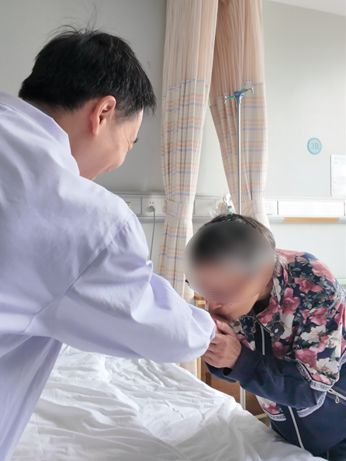
During one ward round, she tightly held the hand of her attending physician, Dr. Zhang Ying, and gently performed a “hand-kiss.” This gesture was not only a token of gratitude for the doctor’s skills, but also for their persistence in not giving up on her despite the complexity of her condition. It symbolized the mutual understanding and support between doctor and patient, and their shared determination to fight the disease together.
Zulfiia does not know what the future holds, but she is very satisfied with the results achieved so far. Today, we see in her a sense of calm, kindness, and a smile. She believes that she will continue to get better.