


Recently, a medical team led by President Niu Lizhi at Guangzhou Fuda Cancer Hospital successfully performed a single-needle Nanoknife (Irreversible Electroporation, IRE) ablation on a patient with a right portal vein tumor thrombus (PVTT), while concurrently ablating a large intrahepatic liver tumor. Featuring "one needle, one single operation" to resolve both PVTT and the primary large liver lesion simultaneously, this case demonstrates new exploratory value in minimally invasive, precision oncological therapy. Multiple mainstream media outlets, including Ifeng News, have reported on this achievement, with the Ifeng News client drawing nearly 500,000 readers.
Dual Challenges: Recurrent Liver Cancer Complicated by Portal Vein Tumor Thrombus
The patient, a 76-year-old female, was diagnosed with a liver tumor in 2025 and underwent surgical resection locally, with postoperative pathology confirming hepatocellular carcinoma (HCC). She was recently admitted to our hospital due to postoperative recurrence. Ultrasound examination revealed a tumor measuring approximately 7.0 cm × 5.0 cm in the right posterior lobe of the liver, along with hypoechoic filling within the lumen of the right portal vein branch, indicative of a right portal vein tumor thrombus.
This presented clinicians with two simultaneous "battlefronts": a massive liver tumor lesion and a tumor thrombus lodged inside the main trunk of the right portal vein.
The portal vein is a vital inflow tract for hepatic blood flow. Managing a tumor thrombus within the main right branch presents substantial technical challenges. Furthermore, the lesion was located adjacent to the confluence of the right bile duct structures and the portal vein, where the lumen is narrow and elongated with highly restricted spatial clearance. Traditional dual-needle or multi-needle placement offers minimal operating space in such tight vascular conduits. Moreover, thermal (hot or cold) ablation in this area is heavily compromised by the "heat-sink effect," where rapid blood flow dissipates ablation energy, undermining treatment margins.
Precision Solution: The Distinct Advantages of Single-Needle Nanoknife
Nanoknife ablation is immune to the blood flow "heat-sink effect" and features a mechanism that selectively spares structural integrity of blood vessel walls. Following a comprehensive clinical evaluation, the team selected single-needle Nanoknife ablation as a targeted local modality.
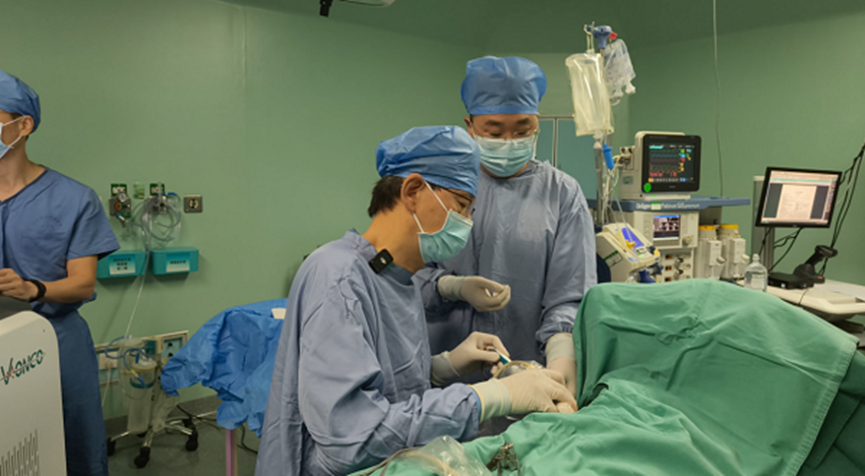
Under real-time ultrasound guidance, President Niu Lizhi served as the lead surgeon. Tailoring the approach to the anatomical terrain, Dr. Niu adopted a single-needle entry path: inserting a fine ablation needle into the narrowed portal vein trunk, with the needle tip precisely positioned at the origin of the tumor thrombus. Upon delivering high-voltage pulses, intraoperative ultrasound revealed microbubbles and tissue blanched around the needle, demonstrating a sharp, well-demarcated ablation boundary with controllable range. Doppler ultrasound confirmed smooth, patent blood flow through the portal vein with no signs of vascular injury.
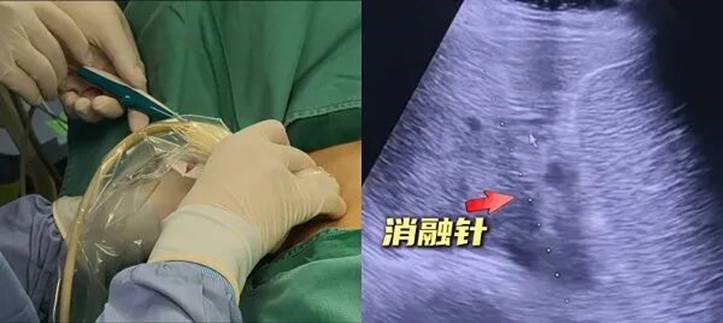
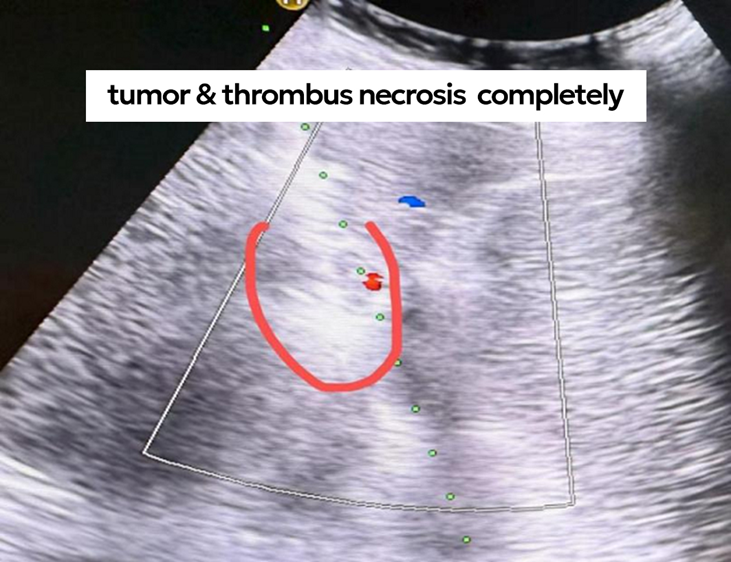
Concurrently, the team ablated the 7.0 cm × 5.0 cm tumor in the right posterior lobe. With just one needle in one surgery, both the tumor thrombus and the large tumor were treated together. The patient entered the operating theater only once, effectively lowering both financial burden and physical trauma.
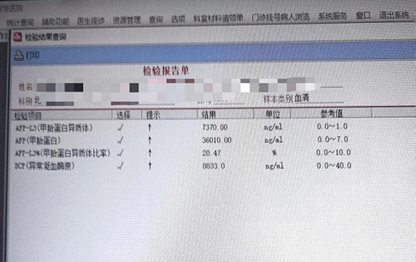
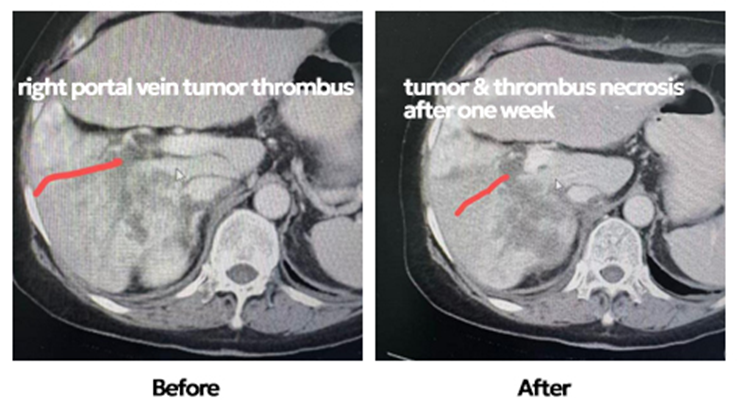
Before
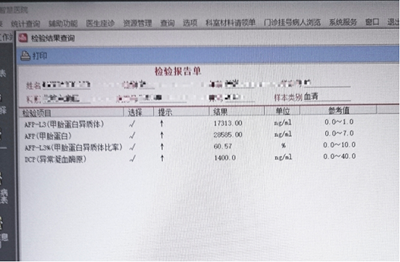
After
Re-examination one week post-surgery showed a significant drop in abnormal prothrombin (PIVKA-II) from over 7,000 preoperatively to around 1,000, while alpha-fetoprotein (AFP) dropped from over 30,000 to approximately 20,000. Follow-up CT imaging confirmed necrosis within the PVTT ablation zone and extensive necrotic changes across the large liver lesion.
This pioneering single-needle Nanoknife ablation transformed a traditionally complex procedure that once required multiple needle configurations into a safer, simpler single-needle approach. The successful implementation of this case offers a novel clinical pathway for local treatment in liver cancer patients with portal vein tumor thrombus, underscoring the team's ongoing pursuit of innovation in precision ablation and minimally invasive care.