


Mouth ulcers are something almost everyone has experienced. When they hurt, eating becomes unpleasant, brushing teeth is uncomfortable, and accidentally biting them is excruciating.
Most ulcers heal on their own within a few days to a week. But there is a kind that lingers—lasting a month, two months, or even a year without healing. That’s when extra caution is needed.
A “sore” that lasted a year turned out to be cancer
Mr. De, 75, is a second-generation Hakka Chinese from Indonesia. Twelve years ago, he went to a dentist because of tooth pain. Strangely, although his teeth were treated, the pain did not improve.
He also developed an ulcer under his tongue.
At first, he didn’t pay much attention. After all, who hasn’t had an ulcer before? He assumed it would go away in a few days.
But days turned into weeks, weeks into months, and eventually a year… Not only did the ulcer fail to heal, it worsened. His tongue became ulcerated, the pain made it difficult to speak, and even eating became torture. Worse still, local doctors told him that there was a tumor in his tongue.
“Isn’t it just a mouth ulcer? How could it turn into cancer?”
This is a question almost every tongue cancer patient asks upon diagnosis.
But the truth is often surprising: it’s not that the ulcer turned into cancer—it was cancer from the very beginning.
There are different types of oral ulcers. The common ones that heal within days are called simple or recurrent ulcers, and they do not become cancer.
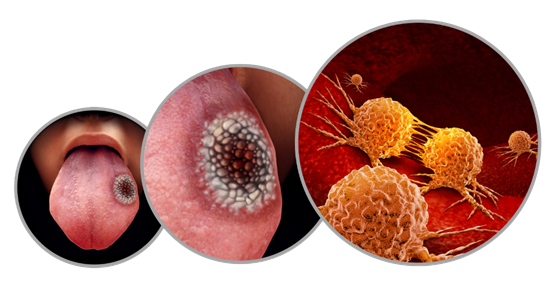
However, the “ulcers” found in tongue cancer patients are malignant ulcers from the start—an early manifestation of cancer. If all oral ulcers are dismissed as “heatiness” and treated with herbal tea or sprays, a minor issue may develop into a serious disease.
A simple self-check during brushing:
Look: Check the tongue and oral mucosa for white or red patches, or signs of erosion.
Feel: Gently touch the tongue or oral mucosa to detect any small, hard nodules.
If you notice any of these signs, seek medical attention promptly.
How was it treated? A three-step approach
After receiving the diagnosis, Mr. De’s first reaction was clear: he needed treatment immediately. But where and how?
A friend suggested: “Don’t rush into surgery. Go to Guangzhou Fuda Cancer Hospital in China—they have minimally invasive options.”
In April 2015, Mr. De traveled to Guangzhou. Examinations revealed a strip-shaped hypermetabolic lesion on the left side of his tongue, measuring about 1.7 × 3.2 × 2.4 cm—roughly the size of a small date. There were also abnormalities in the cervical lymph nodes, raising suspicion of metastasis.
Doctors developed a precise three-step treatment plan:
1. Remove the “root”
The primary tumor, along with a margin of surrounding normal tissue (safe margin), was completely removed—like pulling out the root of the disease.
2. “Freeze” any remaining cancer cells
Cryoablation using argon-helium technology was applied to the surgical area and surrounding tissues to eliminate any residual cancer cells—adding an extra layer of protection.
3. Clear the “escape routes”
A neck lymph node dissection was performed to remove potential metastatic sites and block pathways for tumor spread, reducing the risk of recurrence and distant metastasis.
Postoperative pathology confirmed a well-differentiated squamous cell carcinoma of the tongue, with invasion into muscle tissue and ulcer formation. The good news: surgical margins were clear, and no cancer cells were found in the lymph nodes.
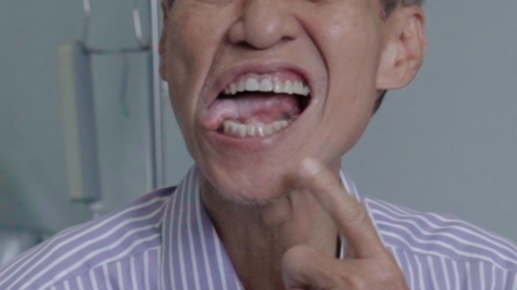
After surgery, Mr. De also received immunotherapy and ozone autohemotherapy to consolidate the treatment effect, boost immunity, and prevent recurrence.
Initially, he had monthly follow-ups, then every three months, then every six months, and now once a year. His speech has become clearer, and his appetite has improved.
“I used to eat everything without restriction. Now I focus on a balanced diet and exercise every day.”
Ten years later, there has been no sign of recurrence.
Returning this time—for his wife
This year, Mr. De returned to the hospital—not for himself, but to accompany his wife.
She had experienced nausea, abdominal bloating, and occasional blood in her stool for two years, but assumed it was minor digestive issues. It wasn’t until symptoms worsened during the Spring Festival that she sought medical help. A 3 cm mass was found in her sigmoid colon.
The family debated treatment options. Mr. De wanted to go directly to Guangzhou, while their son preferred Malaysia. In the end, she chose Guangzhou:
“Your father was cured here—I trust this place.”
In April, she underwent endoscopic submucosal dissection (ESD) to remove the tumor. Pathology showed a villous adenoma with low-grade intraepithelial neoplasia—benign but with malignant potential. Fortunately, it was detected early, and the surgery was successful.
Now, the couple has safely returned home. In their view, life, aging, illness, and death are all part of the natural course. Facing them calmly and seeking active treatment is what matters most.
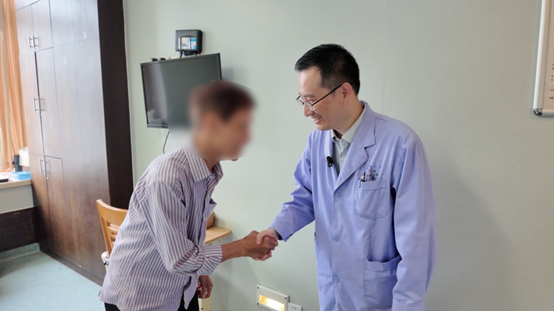
Throughout their journey, they were deeply touched by the care they received—from doctors and nurses to translators and drivers—who treated them like family. It was both a meaningful encounter and a stroke of good fortune.
Reminder
Do not dismiss long-lasting oral ulcers as something minor. If an ulcer does not heal within two weeks, seek medical advice.
Because what seems like a small “ulcer” may be far more serious than it appears.
